Introduction
Hard water is a common household problem that can affect much more than the appearance of your sinks and shower doors. Minerals naturally present in water, particularly calcium and magnesium, can leave deposits on plumbing fixtures, appliances, glass, and other surfaces.
Over time, these minerals can contribute to scale buildup inside plumbing and water-using appliances. You may also notice spots on dishes, soap that does not lather easily, or a chalky residue around faucets.
A properly selected water treatment system can help address these problems. That is why many homeowners consider installing water softeners when hard water becomes a persistent issue.
But choosing a system is not as simple as buying the largest model available. Household water usage, water hardness, family size, available space, maintenance requirements, regeneration method, and operating costs all matter.
This guide explains what to look for when shopping for a water softener in 2026 and how to determine which type may fit your home.
Quick Highlights
- Hard water commonly contains elevated levels of calcium and magnesium.
- Scale can accumulate in plumbing fixtures and water-using appliances.
- Traditional ion-exchange softeners replace calcium and magnesium ions with sodium or potassium ions.
- System capacity should match household water use and water hardness.
- Regular maintenance is important for many conventional systems.
- Salt-based and salt-free systems work differently and should not be treated as identical technologies.
- Testing your water before purchasing can help you choose an appropriate system.
What Is Hard Water?
Hard water contains dissolved minerals, primarily calcium and magnesium.
These minerals occur naturally as water moves through soil and rock. The amount can vary significantly depending on the local water source and geology.
Hard water is not necessarily obvious when you first turn on a faucet. Instead, you may notice its effects over time.
Common signs include:
- White mineral deposits around faucets
- Spots on glasses and dishes
- Scale on shower fixtures
- Reduced soap lather
- Residue on sinks and tubs
- Mineral buildup in some water-using appliances
The severity depends on the mineral concentration and how the water is used.
How Does a Water Softener Work?
Traditional water softener for hard water systems commonly use a process called ion exchange.
Inside the softener is a tank containing resin beads. As hard water passes through the resin, calcium and magnesium ions are attracted to the resin. The system then releases another ion, commonly sodium, into the treated water.
Eventually, the resin becomes loaded with calcium and magnesium. A regeneration cycle is then used to restore the resin’s ability to exchange ions.
Salt is commonly involved in this regeneration process because a concentrated brine solution helps remove the accumulated minerals from the resin.
The exact process varies by system, so homeowners should always follow the manufacturer’s installation and maintenance instructions.
Why Homeowners Install Water Softeners
The main reason to install a conventional softener is to reduce the effects associated with hard water.
Less Mineral Scale
Softened water can reduce the accumulation of calcium and magnesium scale in plumbing fixtures and water-using equipment.
This can be particularly helpful in homes with noticeably hard water.
Easier Cleaning
Hard water can leave mineral spots and deposits on glass, faucets, shower doors, and sinks.
Reducing the hardness of water may make some cleaning tasks easier because there is less mineral residue to remove.
Better Soap Performance
Hard water can interfere with soap’s ability to lather effectively. Softer water may make soaps and detergents behave differently, although the exact experience varies according to the products used and the home’s water chemistry.
How We Evaluate Water Softeners
Choosing the best water softener requires looking at more than the size of the tank.
Capacity
Water softeners have a rated capacity that indicates how much hardness they can remove before regeneration is needed.
A system that is too small may regenerate frequently, while an unnecessarily large system can cost more than necessary.
The appropriate capacity depends on household water use and water hardness.
Regeneration Method
Many modern systems use demand-initiated regeneration.
Instead of regenerating at a fixed interval regardless of actual water consumption, the system monitors usage and initiates regeneration when necessary.
This can help avoid unnecessary regeneration cycles.
Control System
The control valve manages functions such as water flow, regeneration, and programming.
A straightforward control system can make setup and maintenance easier.
Some newer systems may provide additional monitoring features, but homeowners should consider whether those features provide meaningful value for their specific needs.
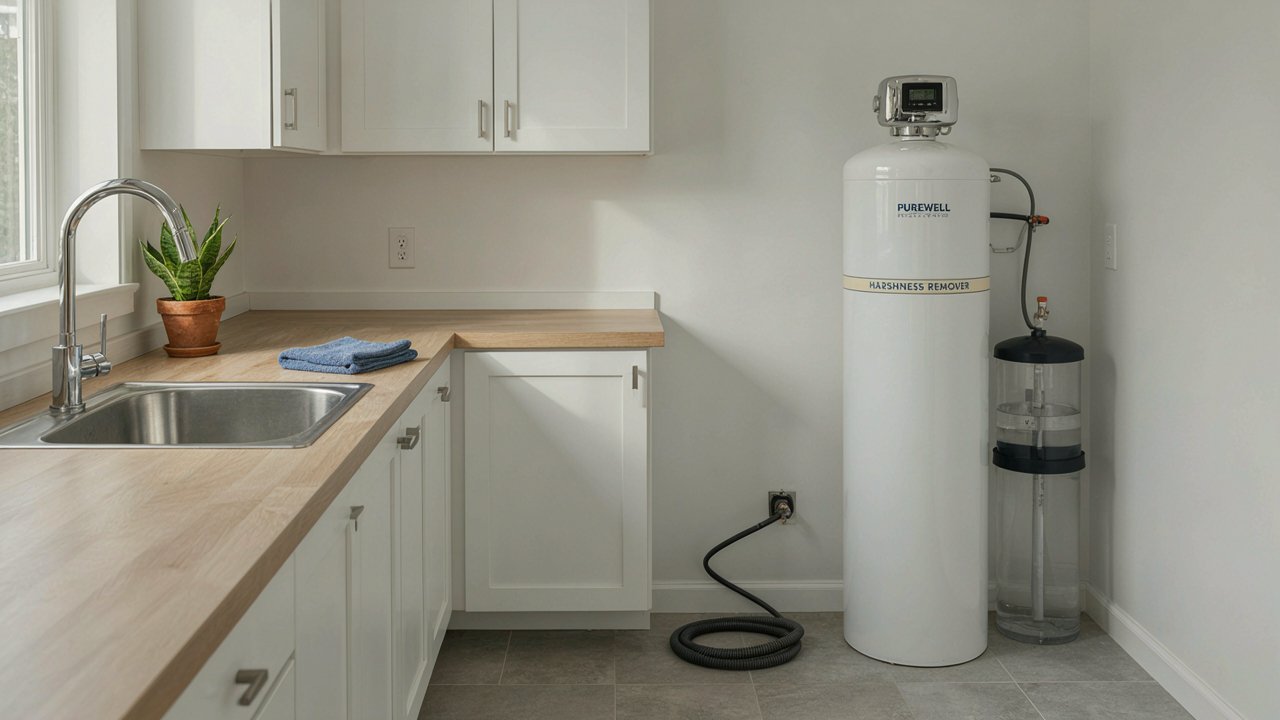
Physical Size
Before buying, measure the space where the system will be installed.
Remember that the installation may require more than just the main tank. Depending on the design, you may need space for a brine tank, plumbing connections, drainage, and access for maintenance.
Salt-Based vs. Salt-Free Systems
One of the most important distinctions when shopping is understanding that salt-based and salt-free systems do not perform the same function.
Salt-Based Softeners
Traditional ion-exchange softeners actually reduce calcium and magnesium hardness by exchanging these minerals for sodium or potassium ions.
They are commonly used when the goal is genuine water softening.
However, they require ongoing maintenance and typically need salt or potassium chloride for regeneration.
Salt-Free Systems
Salt-free products generally use different treatment methods intended to alter how minerals behave or reduce scale formation rather than removing hardness minerals through conventional ion exchange.
Because they work differently, they should not automatically be considered direct replacements for traditional softeners.
If your goal is specifically to remove calcium and magnesium from water, understand the technology before purchasing.
Test Your Water Before Buying
One of the smartest steps before purchasing a system is testing your water.
Water hardness can vary considerably from one location to another. A test can help determine whether you actually have a hard-water problem and how severe it is.
Depending on your situation, you may also want to know about other water-quality characteristics.
For private wells, professional testing can be particularly useful because well water chemistry can vary and may include concerns beyond hardness.
Testing first can prevent you from buying a system that is poorly matched to your home’s water conditions.
Choosing the Right Capacity
A household’s water demand is an important part of sizing.
A larger family generally uses more water than a single-person household. Likewise, a home with multiple bathrooms may have higher potential demand.
To estimate the appropriate system, homeowners typically need information about:
- Household size
- Average daily water use
- Water hardness
- Desired regeneration frequency
- System capacity
Manufacturers may provide sizing calculators or recommendations, but if your water conditions are unusual, professional advice can be useful.
Common Buying Mistakes
Choosing Based Only on Price
The cheapest system may not be the most economical over its entire life.
Consider installation, salt consumption, maintenance, replacement parts, and expected operating costs.
Buying an Oversized System
A larger system is not automatically better.
Oversizing can increase the initial purchase cost and may not provide meaningful benefits for a smaller household.
Ignoring Installation Requirements
Some systems require specific plumbing connections, drainage, electrical access, or other installation considerations.
Check these requirements before purchasing.
Forgetting Maintenance
A water softener is not a completely maintenance-free appliance.
Salt levels, cleaning, settings, and other maintenance requirements depend on the system.
Confusing Softeners With Filters
A water softener and a water filter solve different problems.
A softener is primarily concerned with hardness minerals. A filter may be designed to address sediment, chlorine, taste, odor, or other contaminants depending on its media and certification.
Don’t assume one system can replace every type of water treatment.
How to Maintain a Water Softener
Maintenance requirements vary, but traditional systems commonly require monitoring the salt supply.
Check the manufacturer’s recommended salt level and avoid allowing the system to run without the required regeneration material.
Keep the area around the equipment accessible and reasonably clean.
If you notice changes in water quality, unusual salt consumption, leaks, or error messages, investigate the issue rather than ignoring it.
Periodic professional servicing may also be appropriate depending on the system and local water conditions.
Can a Water Softener Protect Your Pipes?
Hard-water scale can accumulate in plumbing and water-using equipment. Reducing hardness can therefore help limit one source of mineral buildup.
However, a softener is not a guarantee that plumbing will never experience problems.
Pipe condition, water chemistry, temperature, flow, age, and other factors can all affect plumbing performance.
If you already have significant buildup or reduced water flow, a plumber may need to inspect the system separately.
What About Drinking Water?
Homeowners should understand that conventional ion-exchange softeners change the mineral composition of treated water.
Because sodium can be added during the softening process, households with specific dietary or water-quality concerns should discuss their situation with an appropriate professional.
Some homes use a separate drinking-water treatment system for kitchen water while using softened water throughout the rest of the house.
The right setup depends on household preferences and local water conditions.
Questions to Ask Before Buying
Before choosing among water softeners, ask:
- How hard is my water?
- How many people live in my home?
- How much water does my household use?
- How much space is available?
- Do I want a salt-based softener or another treatment approach?
- What maintenance does the system require?
- What are the ongoing operating costs?
- Does the system require professional installation?
- What warranty is included?
- Are replacement parts readily available?
These questions can help narrow your choices and prevent expensive mistakes.
Are Water Softeners Worth It?
For households dealing with significant hard-water effects, a properly sized softener can be a useful part of a broader water-management strategy.
The value depends on the severity of the problem, household priorities, installation cost, maintenance requirements, and the specific treatment technology selected.
If your water is only mildly hard and you have few noticeable problems, a full softening system may not be necessary.
Testing the water first gives you better information on which to base the decision.
Final Buying Guide
The best system for your home is not necessarily the biggest, newest, or most expensive option.
Start by understanding your water.
Once you know the hardness level and household water demand, compare systems based on capacity, regeneration method, installation requirements, maintenance, operating costs, and warranty support.
For traditional hard-water treatment, ion-exchange technology remains an important option because it actually reduces calcium and magnesium hardness in treated water.
Other technologies may have different purposes, so read product specifications carefully rather than assuming all systems provide the same results.
Conclusion
Choosing among water softeners becomes much easier when you understand what your home actually needs. Hard water can leave mineral deposits, affect cleaning, and contribute to scale in plumbing and appliances. A properly sized system can help reduce these effects.
Before buying, test your water, estimate household usage, and understand the difference between genuine softening and scale-control technologies.
The best water softener for one household may not be the right choice for another. Capacity, water hardness, maintenance, installation requirements, and long-term operating costs all deserve attention.
With the right information, homeowners can choose a system based on their actual water conditions rather than simply buying the most heavily advertised product.